


👤 The Biblical Person of the Day
🕊️ Asenath – The Woman at Joseph’s Side in Egypt
📌 Profile
- Name: Asenath
- Time of Birth: Approximately 19th–18th century BC
- Place of Birth: Egypt
- Time of Death: Unknown
- Age: Unknown
- Role: Wife of Joseph and mother of Manasseh and Ephraim
📖 Short Story
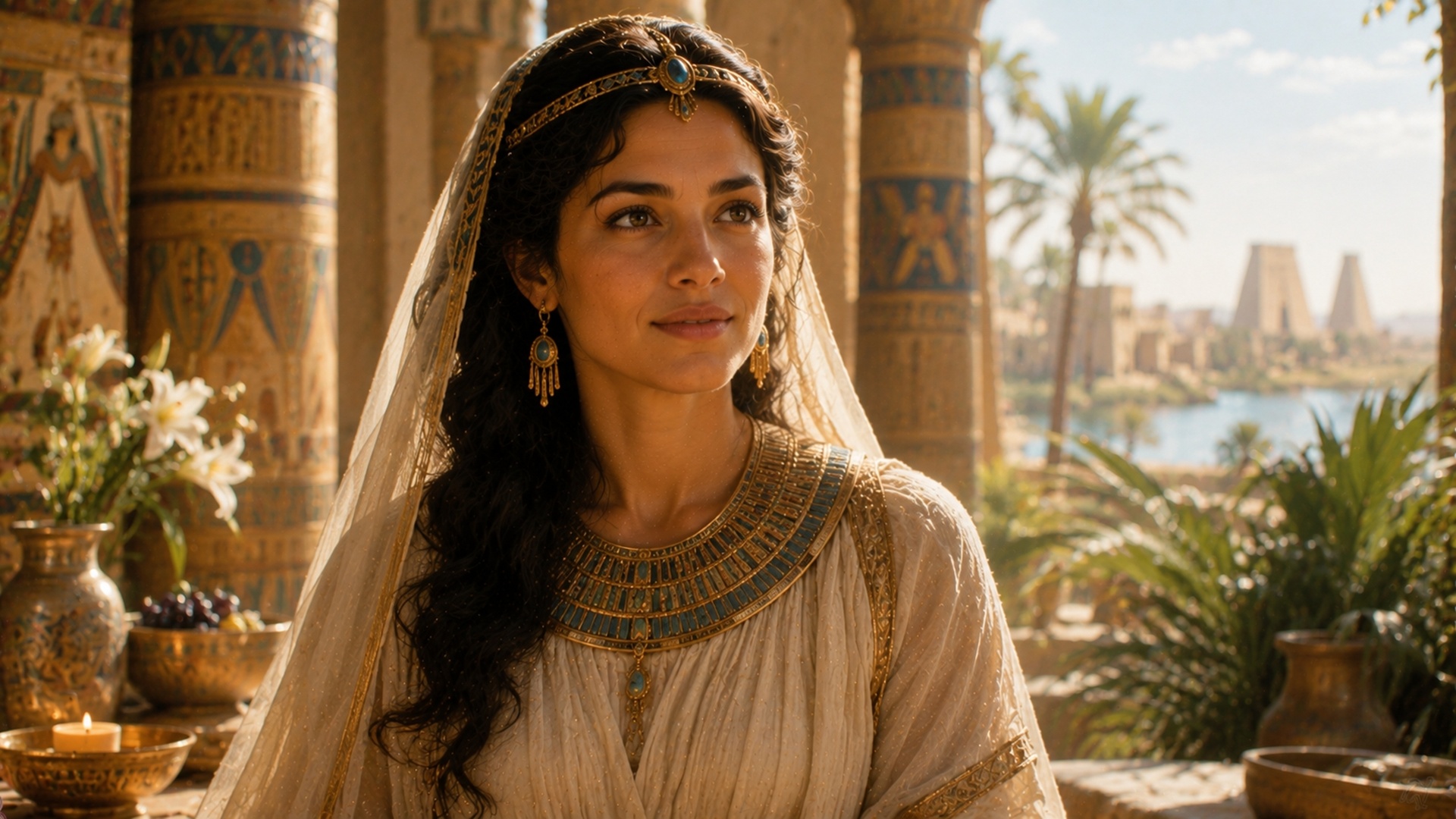
Asenath was an Egyptian woman and the daughter of Potiphera, priest of On. We encounter her in the story of Joseph when, after many years of suffering, God exalted him and gave him a high position in Egypt.
After Joseph interpreted Pharaoh’s dreams, Pharaoh placed him over the entire land of Egypt. As a sign of this new dignity, he also gave Asenath to Joseph as his wife.
Asenath thus became part of a story that extended far beyond Egypt. She entered the life of a man whom God had guided through suffering, faithfulness, and divine protection.
Asenath became the mother of two sons: Manasseh and Ephraim. Jacob later adopted these two children in a special way and gave them a place among the tribes of Israel.
Although Asenath came from Egypt, her sons were included in Israel’s history of promise. Her family thus became a sign that God continues to fulfill His plans even in a foreign land.
The Bible tells us very little about Asenath’s personal life. Yet her place at Joseph’s side was significant because she lived during a time of famine, preservation, and divine guidance.
Asenath’s story shows that God can include people and families in His story through unexpected paths. In Egypt, far from Canaan, a family line grew through her that would later play an important role in Israel.
🔥 The Decisive Moment
Asenath becomes Joseph’s wife and the mother of Manasseh and Ephraim, whose descendants later become important tribes of Israel.
✨ 7 Special Facts About Asenath
- She was an Egyptian woman
- She was the daughter of Potiphera, priest of On
- She was given to Joseph as his wife by Pharaoh
- She lived at Joseph’s side while he carried great responsibility in Egypt
- She became the mother of Manasseh and Ephraim
- Her sons received a special blessing from Jacob
- She was thereby connected with the history of the tribes of Israel
⚖️ Strengths & Weaknesses
✔ became part of God’s guidance in Joseph’s life
✔ stood beside a man who carried great responsibility
✔ became the mother of two important ancestors of Israel’s tribes
✔ her family was included in the history of God’s promise
❌ nothing is explicitly reported about her personal faith
❌ her own voice is not recorded in the biblical account
❗ The Failure That Shaped Her
The Bible does not record any particular personal failure committed by Asenath.
➡️ Her life is shaped primarily by the fact that, as Joseph’s wife and the mother of Manasseh and Ephraim, she became part of God’s greater story.
📜 Key Verse
“And he gave him Asenath, the daughter of Potiphera priest of On, as a wife.” (Genesis 41:45)
🧠 The Life Lesson
God can include people in His great plan even in foreign lands, through unexpected relationships, and through quiet family stories.
🎯 Application for Today
Do not underestimate the significance of a quiet place in God’s story. Not everyone is mentioned in many words, but through family, faithfulness, and hidden paths, God can prepare the future.
❓ A Question for You
Where might God be quietly and almost invisibly including your life in a greater story that you cannot yet fully understand?
📌 Context
Asenath lived in Egypt during the time of Joseph, when God used Joseph’s wisdom to preserve many people throughout the famine.
🔗 Connections
Asenath is connected with Joseph, Pharaoh, Potiphera, Manasseh, Ephraim, and the later history of the tribes of Israel.
Conclusion:
Asenath shows that God also works through people about whom very little is recorded. Her story reminds us that quiet lives can acquire a significance in God’s hands that extends far beyond their own time.
See you tomorrow with the next biblical person! 📖
✨ The Life Story ✨
✨ The Life Story of Asenath – Mother of a Line of Promise ✨
🌄 A Woman from Egypt
Asenath was a woman from Egypt. She was the daughter of Potiphera, priest of On, and therefore belonged to a setting shaped by Egyptian culture, religion, and social prominence.
The Bible tells us nothing about her childhood, inner life, or personal thoughts. She enters the story only at the moment when Joseph, after many long years of testing, is suddenly exalted.
This brief mention demonstrates that some people receive only a few verses in the Bible and yet stand at important turning points in the history of salvation.
🌙 Joseph After His Suffering
Joseph had passed through a long and painful journey. His brothers had sold him, he had been taken to Egypt as a slave, falsely accused, and thrown into prison.
Yet God was with him. When Pharaoh had dreams that no one could interpret, Joseph was brought out of prison and, through the wisdom God gave him, provided their interpretation.
This interpretation not only saved Joseph, but also prepared the way for many people to be saved during the coming famine.
👑 Joseph Is Exalted
Pharaoh recognized Joseph’s wisdom and placed him over the entire land of Egypt. Joseph was clothed with royal authority and given the responsibility of preparing Egypt for seven years of abundance followed by seven years of famine.
In this context, Pharaoh also gave Joseph an Egyptian name and Asenath as his wife.
For Asenath, this meant that her life became connected with a man whose story had been shaped by God’s guidance, even though that guidance had led him through deep valleys.
🕊️ At Joseph’s Side
Asenath became the wife of a man who suddenly carried great power and responsibility. Joseph had to gather provisions, organize the administration, make decisions, and guide an entire nation through an approaching crisis.
The Bible does not describe Asenath’s part in this period in detail, yet her place at Joseph’s side belonged to this phase of his life.
She lived with him during a time when God’s wisdom became visible in practical ways. Through Joseph’s faithful service, people were preserved from starvation.
👶 The Birth of Manasseh
Asenath gave birth to Joseph’s first son, Manasseh. Joseph gave him this name because God had made him forget all his hardship and all his father’s household.
This name did not mean that Joseph erased his past. Rather, it testified that God was able to grant healing and a new beginning.
For Asenath, Manasseh became the first son in a family that stood between Egypt and the history of God’s promise.
🌿 The Birth of Ephraim
Asenath also gave birth to Joseph’s second son, Ephraim. Joseph gave him this name because God had made him fruitful in the land of his affliction.
This name carries a particularly profound meaning. Despite his high position, Joseph called Egypt the land of his affliction because he had not forgotten the pain of his journey.
Yet it was precisely there that God granted fruitfulness. Through Asenath, Manasseh and Ephraim were born—two sons who would later become highly significant in Israel.
👴 Jacob Blesses Her Sons
When Jacob was old, Joseph brought his two sons to him. Jacob adopted Manasseh and Ephraim in a special way and placed them on the same level as his own sons.
Asenath’s sons were therefore not regarded merely as Joseph’s children, but received a special place among the tribes of Israel.
For Asenath, this meant that her children, born in Egypt, were included in the line of promise.
🤲 The Blessing upon Ephraim and Manasseh
Jacob blessed Joseph’s two sons. In doing so, he crossed his hands and placed his right hand on Ephraim, the younger son, and his left hand on Manasseh, the firstborn.
Joseph initially tried to correct this, but Jacob refused to change his hands. He knew what he was doing and spoke prophetically about the future of both sons.
In this way, Asenath’s family visibly became part of God’s sovereign guidance. Human origin, birthplace, and cultural background could not limit God’s plan.
🌍 A Bridge Between Egypt and Israel
Asenath stands in the biblical story like a quiet bridge. She came from Egypt, but through Joseph, her sons were included in Israel’s history.
This makes her story especially significant. She reminds us that God’s paths sometimes cross boundaries that people would keep clearly separated.
An Egyptian mother gave birth to two tribal ancestors whose names continued to live on in Israel.
🕯️ A Quiet Life with a Great Impact
Asenath does not speak in her own words anywhere in the biblical account. We hear no prayer from her, no speech, and no personal decision.
Nevertheless, her place is significant. Manasseh and Ephraim could not have been born without her, and her role as their mother connected her with Israel’s future.
This reminds us that God’s story does not advance only through the loudest voices. Quiet people often exert an influence that reaches far into the future.
✨ The Enduring Message of Her Life
Asenath demonstrates that God includes even those who receive little visible mention in His great purposes. Her name appears at the point where Joseph’s path of suffering gives way to responsibility, family, and fruitfulness.
Her story reminds us that God causes the future to grow even in a foreign land. What began in Egypt later became part of Israel’s history.
🌌 Closing Thought
Asenath was an Egyptian woman who was placed at Joseph’s side and became the mother of Manasseh and Ephraim.
Her own voice remains hidden, yet through her sons, her life became connected with the history of God’s promise.
👉 Her life story shows that God can use quiet lives, foreign places, and unexpected relationships to continue fulfilling His promises.
